
Porochista Khakpour, in her review for The New York Times, wrote, “All the trigger warnings on earth cannot prepare a reader for the traumas of this Korean author’s translated debut in the Anglophone world.” Han Kang wrote “The Vegetarian” in 2007. The book won the Nobel Prize in 2024.
It starts with a husband complaining about how his plain wife had suddenly acquired a trait, which had become the only interesting thing that he had ever observed about her. The wife, Yeong-Hye, had become a vegetarian.
Throughout the book, everyone is trying to make sense of this affliction, which has befallen their wife, daughter, sister and sister-in-law. Giving up meat might not have been a big deal anywhere else or for anybody else, but in a strictly patriarchal society such as in Korea, with its rules and norms, even something as simple as giving up meat can cause commotion and distress.
The book is filled with violence and abuse, the main recipient of which is Yeong-Hye and has been for most of her life. Being abused by her father and then assaulted by her and her sister’s husbands, she was perhaps refusing to participate in the cycle of abuse any longer, by refusing to harm and consume any living creature. This impulse was caused by a violent dream, which would haunt Yeong-Hye repeatedly.
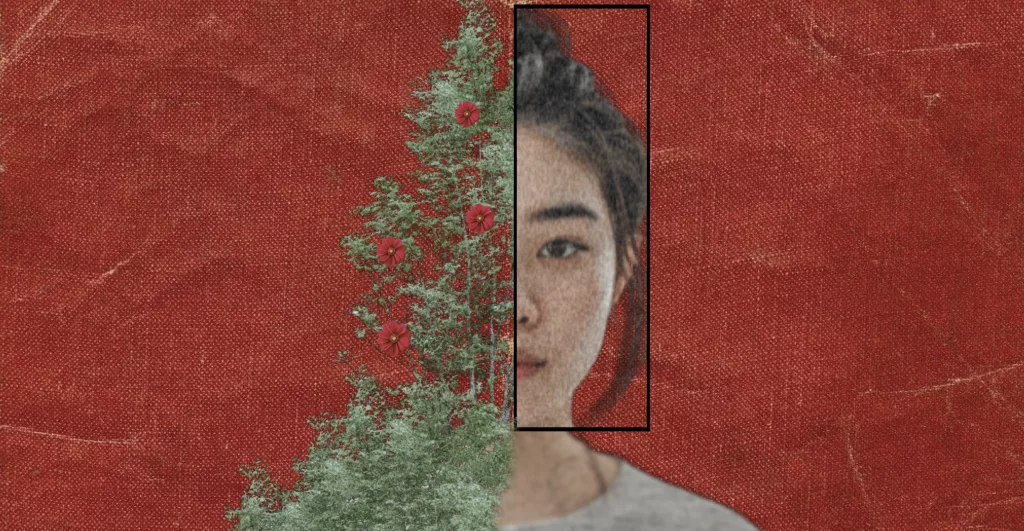
By the end of the book, she is completely rejecting her “humanness” with attempts to take root in the ground as a tree by standing on her hands and sitting naked under the sunlight to photosynthesize. At this point, she is refusing to eat altogether, believing that, as she has become a part of nature, that kind of sustenance is not needed for her anymore.
Most of the people in her life eagerly took advantage of her before abandoning her just as soon as she was admitted to the mental hospital. The only person taking care of her was her elder sister, In-Hye.
Towards the end of the book, In-Hye is the one who has any significant development as a character. “The lives of all the people around her had tumbled down like a house of cards–was there really nothing else she could have done?” In-Hye kept rummaging through her past, remembering the abuse that her sister endured at the hands of their father and the silent compliance she had developed as a coping mechanism to protect herself. She took the ordinary path in life, the ordinary which is considered to be good, even successful. A business, a husband and a child. An unhappy but somewhat bearable life that would have continued had her husband, an “artist” whose perceived genius was something In-Hye had attributed to him, to once again cope with what was actually real, not taken advantage of by her sister.
I got the impression that the only person she was grieving for was her sister, trying to understand her, going into the forest, and trying to find the solace that Yeong-Hye was able to find in the trees and nature, but failing ultimately. She holds her sister’s hand as she is dying and looks out of the window at the trees with a fierce gaze. Yeong-Hye gave up on her “humanness” because it had not served her in any way, so perhaps she thought that becoming something else would free her from the constant abuse she was made to endure.
Yeong-Hye’s circumstances and refusal to participate in the life that was not meant for her transformed In-Hye’s life as well, letting her experience the grief she had never allowed herself to feel over a life she had never truly lived.
This was a unique story that gives insight into the lives of women who are often suppressed by the societies they live in. Some, like Yeong-Hye, lose the thread of life and try to find comfort anywhere else and refuse to participate in the routine of a life that never served them in any way. Some, like In-Hye, hold on to the thread and go on. Han Kang portrays the violent parts of the human condition in a way that’s sometimes disturbing, emotional, and very raw. As Porochista Khakpour mentions, no trigger warnings will be enough to prepare someone who wants to read the book for the portrayal of violence in it. Nonetheless, the book is definitely worth reading, for the original way in which it portrays the essence of violence, especially violence that women have to endure during their lifetime.