
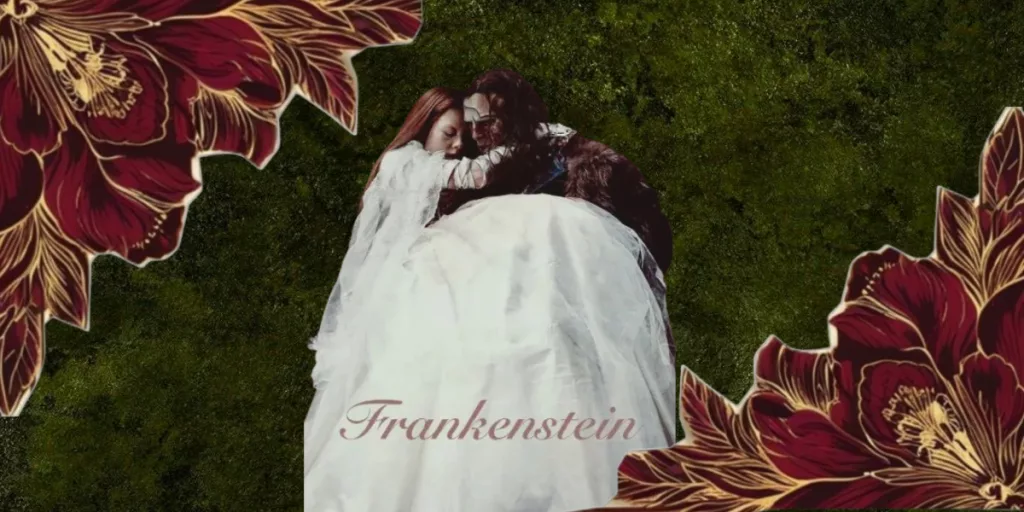
‘Victor. I forgive you. Rest now, Father. Perhaps now, we can both be human.”
The Creature (Frankenstein, 2025)
Guillermo del Toro’s “Frankenstein” (2025) is a visual and emotional tour de force, a film that is as haunting as it is heartbreakingly human. From the very first frame, del Toro’s version is unmistakably moody and gothic, with intricate detailed sets and camera work that pulls us into a painfully real, yet fantastical world.
The film tells the story of Victor Frankenstein (played by Oscar Isaac), a brilliant but arrogant scientist who defies nature by creating a new life out of assembled human corpses. From the moment his creation opens its eyes, Victor rejects and abandons it, leaving a being both innocent and terrifying to navigate a world that sees him only as a monster. The rest of the story follows the consequences of Victor’s actions and arrogance.
Jacob Elordi is at the center of the action and delivers a performance that is nothing short of extraordinary. His portrayal of The Creature is filled with rage, grief and hope, emotions that are so undeniably human that viewers are forced to confront their own empathy (or lack thereof) and understanding of monstrosity. Elordi makes it impossible to reduce The Creature to a mere monster only. Instead, we see a character wrestling with existential questions and the desire to belong in a society that refuses him.
Victor, on the other hand, is the perfect foil. His cockiness creates life but cannot bear the responsibility of it. His fear and inability to embrace imperfection reveal a man whose moral failings may be greater than those of the monster he despises. The film flips the classic narrative by constantly asking the audience: who is the real monster?
This has been a point of debate for many. Some argue that the film only humanizes The Creature while villainizing Victor, and of course, since the film is in conversation with Mary Shelley’s 1818 novel, it raises questions about fidelity to the source material. Shelley’s text is more morally ambiguous and complex because The Creature is neither wholly villain nor wholly victim. In this sense, the novel is less about a simple tale of horror and more about the philosophical question of what it means to be human.
But Del Toro’s film does not try to replicate the book beat by beat. In an interview, he even acknowledges that the novel has become part of his life, but that he intends the adaptation to reflect his personal themes (father and son, creator and creation) more than a strictly faithful reenactment.
With this in mind, it makes more sense why The Creature is so fully humanized in del Toro’s adaptation and why we immediately empathize with him while despising Victor. The Creature is scorned, yet he possesses a depth of feeling and moral discernment that far surpasses his creator’s. He is capable of love, of longing and of forgiveness, and his capacity for compassion makes him, paradoxically, more human than the man who brought him into existence.
The ending also reinforces this. The Creature’s decision to forgive Victor, despite unimaginable suffering, is an affirmation of his humanity. Letterboxd movie reviewers argue, however, that he does not forgive purely out of compassion, but out of pragmatism, since he realizes that if he does not, he will be condemned to an eternity of rage and torment over his own existence. Yet even this reasoning is deeply human, because self-preservation, reflection, and the recognition of one’s own limits are aspects of moral agency. In other words, even if his forgiveness is partially motivated by self-interest and selfishness, the act itself requires awareness, understanding and a kind of ethical reasoning that is profoundly human.
The film is a meditation on responsibility, empathy, and the consequences of our actions because humanity is not a matter of origin or appearance, but of choice, understanding, and morality.