

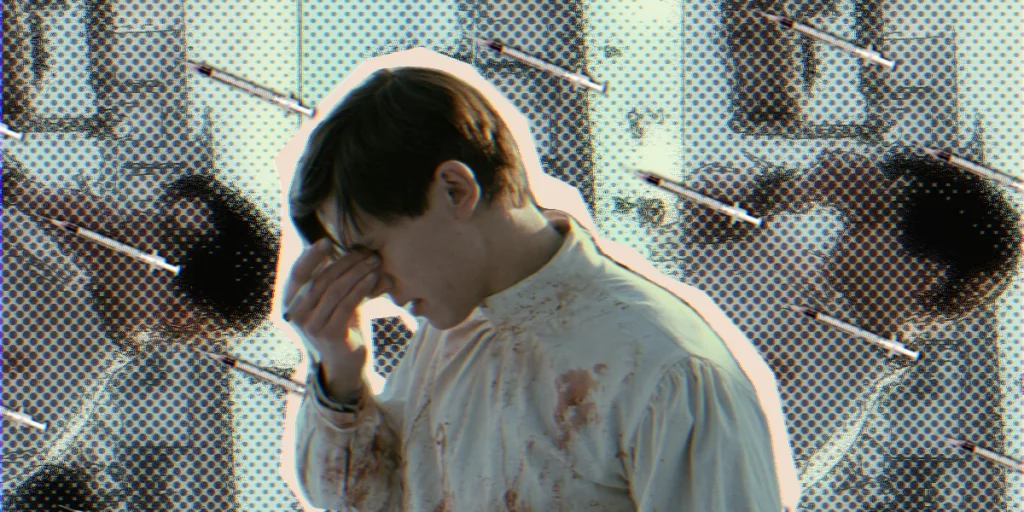
Dr. Bomgard showed the world Sergei Polyakov’s torture, while Polyakov, a hopeless drug addict was calling out for help and lasping into outburst of self–pity.
Published in 1927, Mikhail Bulgakov’s “Morphine” depicts a tragic story of an addiction and its terrifying consequences. It tells the story of Sergei Polyakov, a young doctor who falls into the trap of drug addiction and watches his life falling apart. Through the exposure of his diary, the story shows the subtle beginning of Dr. Polyakov’s addiction to morphine, its evolution and, finally, the horrifying end that Polyakov chooses and embraces.
The events of the book take place in 1917-1918. The story begins from the point of Dr. Bomgard, who receives a letter from his university friend and colleague Sergei Polyakov, asking Bomgrad to visit him as he is severely ill.
Later, Bombard finds out that Polyakov is in the hospital after shooting himself. Polyakov hands his diary and a letter to Bomgard before death. The diary unfolds Polyakov’s “severe illness,” that starts after Polyakov gets morphine injection to relieve his strong stomach ache. Polyakov’s relief under the morphine influence, and regular injections, increased the dosage over time and eventually turned him into a drug addict.
Mikhail Bulgakov’s own experience was what formed the basis for his work “Morphine.” The author himself was a young doctor, and during his life Bulgakov himself became addicted to morphine for some period. According to Bulgakov’s biographical details available on Culture.ru, the writer was under the risk of catching diphtheria after a surgery. According to the culture portal, Bulgakov resorted to morphine injection as a treatment after using an anti-diphtheria medication and facing a sudden allergic reaction to it. Bulgakov’s experience with morphine addiction adds realistic and emotional layers to the story.
What makes the book even more intriguing is its structure. The events are illustrated through a text in the form of a diary, which makes readers feel very close to the main character Sergei Polyakov. That form creates a feeling of intimacy, an impression of reading someone’s hidden, secret thoughts, and having direct access to that person’s actual feelings.
The work also shows how truly horrifying a drug addiction can be in reality, without romanticizing it and making it look “aesthetic.” “To die of thirst is a heavenly, blissful death compared with the craving for morphine,” (p. 13) wrote Polyakov in his diary. Denial, inability to quit, hallucinations and sudden episodes of vomiting, sick body, sick organs. All these are the consequences that Polyakov gets because of his drug addiction, and he does not immediately notice his own body was decaying alive, which clearly depicts not only the body changes, but also the mind distortion after drug usage.
Finally, it is also interesting to notice how far an addict can go for the substances, and how the moral values of the addict can “deform.” Polyakov runs away from the hospital where he was getting treatment for his addiction. He is fearful and stressed. He is afraid that others will find out that he has stolen morphine from the hospital, that he has become a thief. TThis is one of the most suspenseful parts of the novel, as readers can feel the. despair and hopelessness of a person that is drowning in the swamp of addiction and is becoming capable of doing anything to acquire the desirable but deadly substance.
“It would be shameful to prolong my life a minute more. Certainly not a life like mine,” (p. 21) writes Polyakov in his last note of his diary. He ends his life with a revolver shot, believing he ruined his and his beloved colleague Anna’s lives, who had lost her peace witnessing his gradual death in front of her eyes.
“Morphine,” a book that starts with one character’s happiness and relief, turns into a fragment of another character’s tragic story. It leaves with some bitter aftertaste, vividly representing the real impact and consequences of drug usage.



love this! thank you for the review
Thank you for the wonderful book review